Principles of Proportion in Buttock Aesthetics: Waist–Hip Ratio, Pelvic Anatomy, and Modern Aesthetic Approach
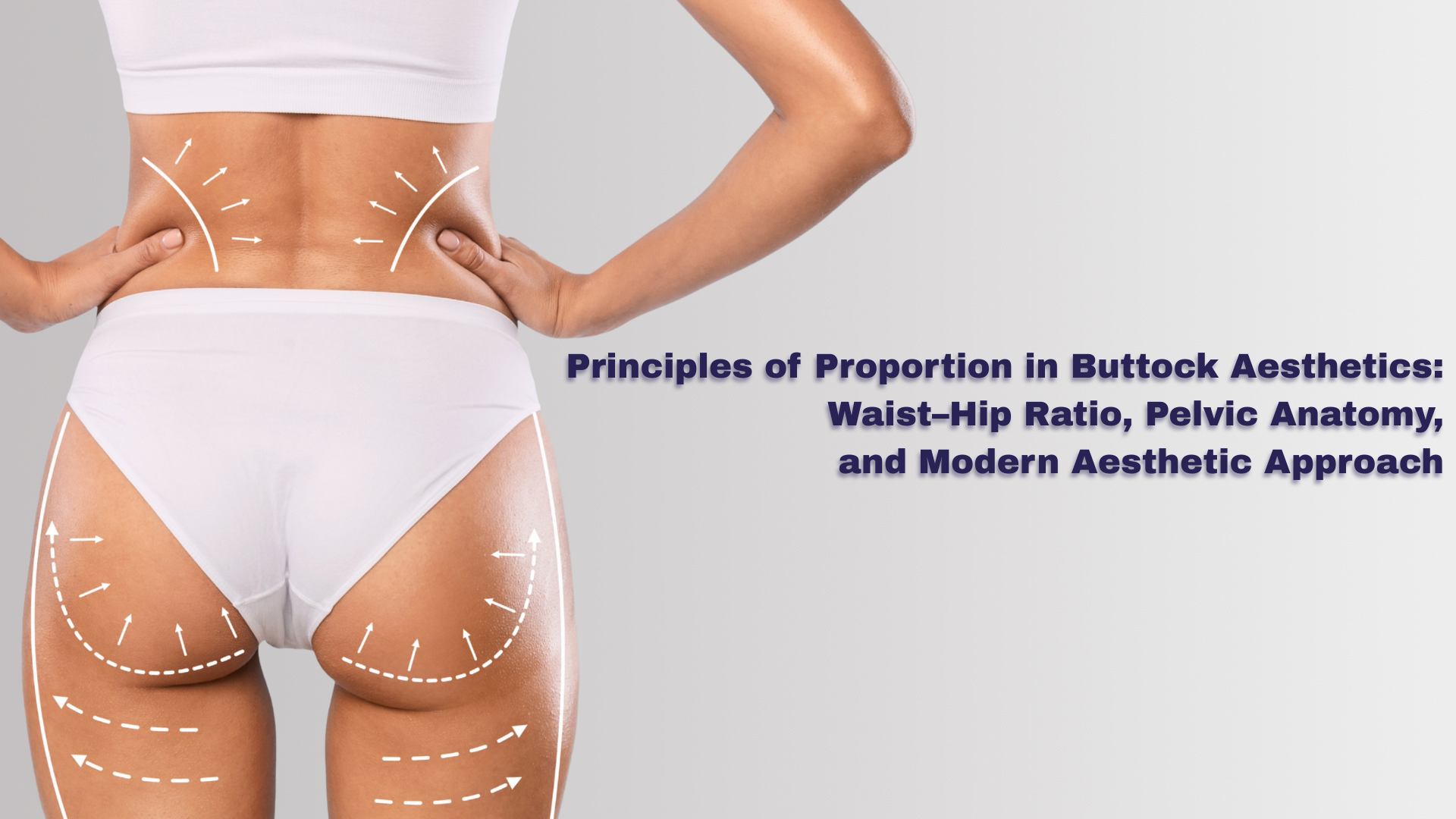
Buttock aesthetics is not evaluated as an isolated region; modern aesthetic surgery approaches the body as a whole with proportional harmony. Therefore, buttock surgery is not merely about adding volume — it is a three-dimensional contour design planned together with the waistline, lower back curve, pelvic structure, thigh transition, and soft-tissue balance.
The appearance of the buttocks is the result of both anatomical and functional structure. Today’s goal in aesthetic surgery is to achieve a balanced, harmonious, and body-compatible buttock shape rather than creating an exaggerated appearance.
Waist–Hip Ratio: Scientific and Aesthetic Foundation
Scientific literature shows that the Waist–Hip Ratio (WHR) plays a key role in body aesthetics.
Waist–Hip Ratio = Waist circumference / Hip circumference
Although the aesthetically favorable ratio is generally suggested to be:
- 0.65 – 0.75
there is no single universal standard. Ethnicity, tissue quality, fat distribution, skeletal proportions, and body structure differ from person to person. Therefore, individualized buttock design is essential. Modern surgical philosophy focuses on anatomical harmony rather than creating mathematical clones.
Pelvic Anatomy and Buttock Shape
The pelvis is the primary anatomical reference defining buttock form. Pelvic width and angulation significantly influence natural buttock shape.
Pelvic Width
- Wide pelvis → potential for naturally wider buttocks
- Narrow pelvis → projection and three-dimensional shaping gain priority
Lumbar Curve and Pelvic Tilt
Lower back curvature (lordosis) enhances buttock projection and contour definition. Surgical planning supports this natural line.
Goals of buttock aesthetics:
- Smooth transition from waist to buttock (S-curve)
- Preservation of lumbar curvature
- Volume planning aligned with pelvic structure
Soft Tissue Balance: Muscle, Fat, and Skin Harmony
The buttock shape is not determined by fat alone; it is the combined outcome of muscle, fat, and skin integrity.
Muscular Structure
Gluteal muscles (gluteus maximus, medius, minimus) form the structural base of buttock shape. Respecting muscle anatomy is essential in surgical design.
Fat Distribution
Fat is naturally stored in genetically programmed areas. In aesthetic surgery, the aim is to:
- Slim the waist and lower back
- Optimize lateral hip and lower buttock lines
- Enhance projection and width
- Preserve natural anatomical transitions
This comprehensive perspective is referred to as 360° body contouring.
3D Analysis and Contour Philosophy in Buttock Aesthetics
Modern buttock aesthetics evaluates not only the buttocks but the entire lower torso and leg transition as a three-dimensional frame.
Key contour regions:
- Upper buttock fullness (upper butt shelf)
- Main mid-gluteal volume
- Infragluteal fold (lower crease)
- Lateral hip indentation (hip dips)
- Waist and lower-back curve
Approach to Hip Dips
In some patients, lateral indentations are prominent. The goal is not to fill every hollow; instead, it is to reinforce anatomically correct transitions.
Surgical Principles and Safety
Technique selection must always be patient-specific:
- Liposuction with fat transfer (BBL approach)
- Implants in selected candidates
- Fascia and tissue support techniques
- Ultrasound-guided fat injection when required
International Safety Standards
Current medical guidelines emphasize:
- No intramuscular fat injection
- Fat placed only in safe, superficial subcutaneous planes
- Micro-fat injection with multi-channel technique
- Ultrasound confirmation for safety when indicated
- Low-pressure fat harvesting and purification
These are globally accepted gluteal safety protocols and form the foundation of patient safety.
Healing and Long-Term Tissue Adaptation
Long-term contour stability depends on:
- Controlled sitting and pressure management (first weeks are critical)
- Gradual mobilization
- Lymphatic support
- Proper nutrition and hydration
- Avoiding major weight fluctuations
The goal is not only an immediate postoperative result but long-term silhouette preservation.
International Patients and Istanbul Preference
Worldwide search trends frequently include:
- “Best BBL surgeon Istanbul”
- “Board-certified body contouring surgeon Turkey”
- “Ultrasound-guided BBL Turkey”
These searches demonstrate that patients are prioritizing science, safety, and anatomical expertise. Istanbul stands out globally due to experienced surgeons and advanced medical infrastructure.
Overall Perspective
Buttock aesthetics is not merely volume enhancement; it is an advanced surgical discipline shaped by:
- Skeletal and anatomical assessment
- Waist–hip proportion optimization
- Muscle and fat balance planning
- Three-dimensional body architecture
- Safe surgical techniques
- Long-term tissue support
The true goal is not “a bigger butt,” but a harmonized body silhouette tailored to the individual’s anatomy.
Physician Information
Assoc. Prof. Dr. Sedat Tatar is a Plastic, Reconstructive, and Aesthetic Surgery specialist who is Double Board Certified by two international boards. He holds the titles of Fellow of the American College of Surgeons (FACS) and Fellow of the European Board of Plastic, Reconstructive and Aesthetic Surgery (FEBOPRAS).
His international professional memberships include ISAPS (International Society of Aesthetic Plastic Surgery) and ASPS (American Society of Plastic Surgeons).
His clinic is located in Istanbul and is officially authorized by the Turkish Ministry of Health as a Health Tourism Center. His company is registered in the United Kingdom & Wales.
CONTACT INFORMATION
Telephone No : +90 (555) 100 10 83
Contact Link : [email protected]
Address : Levent District, Karanfil Araligi Street No: 18 Besiktas/ISTANBUL